
Certificate of Conformity (COC) for passenger cars. PDF delivery within 5 business days.
Check the VIN (Chassis Number) to see if the COC is available




SIMPLE ONLINE PROCESS
How to order a Certificate of Conformity for your vehicle
Order your Certificate of Conformity online in four simple steps.
Secure ordering
Clear and protected process
01
STEP 1
Select your vehicle
Choose the correct vehicle category, manufacturer and Certificate of Conformity service.
02
STEP 2
Enter the vehicle details
Provide the VIN and the vehicle registration document. If the vehicle originates from outside the EU, you must also attach the manufacturer ID plate in the appropriate field.
03
STEP 3
Complete your order
Review the information entered and complete the payment through our protected checkout.
04
STEP 4
Receive your COC
Your order is processed and the Certificate of Conformity is delivered based on the selected service (5 business days for the PDF format and approximately 15 business days to receive the physical format, IF REQUESTED).
CUSTOMER REVIEWS
Customer reviews of FastCOC
452 Verified Reviews
Top Reviews
TOP REVIEW
MS
1 day ago
Michael Schneider
Germany
Fast, clear and professional
“The entire process was extremely simple. I submitted my vehicle information and received the certificate quickly, with clear communication throughout the order.”
TOP REVIEW
LB
4 days ago
Luca Bianchi
Italy
Excellent service from start to finish
“I needed the Certificate of Conformity for my vehicle registration. The document arrived exactly as requested and the customer support was professional and responsive.”
More Verified Reviews
SD
1 week ago
Sophie Dubois
France
A reliable and efficient service
“Ordering was straightforward and the instructions were very clear. I received regular updates and the final document was perfect for my registration procedure.”
CM
1 week ago
Carlos Martínez
Spain
Very satisfied with my order
“The website was easy to use and the service was faster than expected. Everything was handled professionally and the certificate contained the information I needed.”
AK
1 week ago
Anna Kowalska
Poland
Simple process and great support
“A smooth experience from the initial order to the delivery of the document. Customer support answered my question quickly and clearly.”
Frequently asked questions about the Certificate of Conformity (COC)
What is the Certificate of Conformity (COC)?
The Certificate of Conformity (COC) for vehicles is an official document that certifies a car, motorcycle, or commercial vehicle complies with the technical and environmental standards required by a specific market, such as the EU Whole Vehicle Type Approval. It confirms that the vehicle meets safety, emissions, and construction regulations set by law.
The COC is commonly required when registering an imported vehicle, especially within the European Union.
Registration authorities use it to verify that the vehicle type has been approved and can be legally driven on public roads without additional technical inspections.
This certificate is usually issued by the vehicle manufacturer or an authorized representative and includes key details such as the Vehicle Identification Number (VIN), model, engine specifications, and approval references.
Having a valid COC simplifies vehicle registration, reduces administrative delays, and ensures full regulatory compliance.
What does the Certificate of Conformity (COC) Contain?
The Certificate of Conformity (COC) for vehicles contains detailed technical and identification information that proves the vehicle complies with applicable regulations and type-approval standards. It includes essential data that authorities use to verify the vehicle’s conformity during registration or import procedures.
Typically, the COC lists the vehicle manufacturer, brand, model, and Vehicle Identification Number (VIN). It also provides technical specifications such as engine type, fuel type, engine capacity, power output, emissions standards, CO₂ values, and noise levels. In addition, the certificate includes approval references, applicable regulatory directives, and the date of issue.
It is officially signed or stamped by the manufacturer or authorized authority, ensuring the document’s authenticity and legal validity for vehicle registration and use.
What are the Waiting Times for Obtaining a COC?
The waiting times for obtaining a Certificate of Conformity (COC) for vehicles vary depending on the manufacturer, vehicle brand, and country of origin. In general, the time it takes to issue a certificate of conformity is 7-14 working days.
For newer vehicles with standard type approval, a COC is often issued more quickly, as the technical data is readily available in the manufacturer’s system. Older, imported, or less common models may require additional verification, which can extend the waiting period.
Delays may also occur due to high demand, missing vehicle information, or administrative checks by the issuing authority. Providing accurate vehicle details, such as the VIN, helps ensure faster processing and reduces potential waiting times.
Are your Certificates of Conformity original?
Yes, our Certificate of Conformity (COC) documents for vehicles are 100% original and fully authentic. Each COC is issued directly by the vehicle manufacturer or by an officially authorized representative, in accordance with applicable regulations and type-approval requirements.
The certificates provided are identical to those supplied by manufacturers and are recognized by registration authorities, customs offices, and technical inspection services. They include all official references, security elements, and required technical data to ensure full legal validity.
We guarantee that every COC we deliver is genuine, verifiable, and accepted for vehicle registration and import procedures, giving you complete confidence and peace of mind throughout the process.
Is the COC Accepted by the Motor Vehicle Authority?
Yes, the Certificate of Conformity (COC) is officially recognized by Motor Vehicle Authorities in the EU and many other countries. It serves as proof that the vehicle complies with safety, emissions, and technical standards required for registration.
Authorities use the COC to verify that the vehicle meets all legal requirements, allowing registration without additional technical inspections for type-approved vehicles. It includes essential information such as the VIN, engine specifications, and regulatory approval references, which are required by registration offices.
How Long is the COC Certificate Valid?
The Certificate of Conformity (COC) for vehicles does not usually have an expiration date and is valid indefinitely. It confirms that the vehicle complied with the applicable regulations and type-approval standards at the time it was manufactured.
As long as the vehicle remains in its original, unmodified condition, the COC can be used at any time for registration or import procedures. Registration authorities rely on the information in the certificate to verify conformity, even years after the vehicle was produced.
Is a COC valid in EU and EEA countries?
Yes, a Certificate of Conformity (COC) issued under EU Whole Vehicle Type Approval is valid in European Union and European Economic Area countries. It allows a vehicle to be registered in any EU country without the need for additional technical tests or approvals.
Registration authorities across Europe recognize the COC as official proof that the vehicle meets EU safety, environmental, and technical standards. This makes cross-border vehicle registration simpler and faster when moving or importing a vehicle within the EU.
How can I order a COC online?
Ordering a COC Certificate of Conformity online is a simple and convenient process. First, you need to provide some basic vehicle information, including the Vehicle Identification Number (VIN) and a scan of the vehicle registration document.
Next, you need to complete the online order form. Once the request is processed, the COC is typically delivered via email, in digital format, or by courier, depending on the customer's location on the COC order page.
Ordering online ensures a faster process, secure payment, and allows you to track the status of the certificate until it is received.
Can I Register my Vehicle Without a COC?
No, you cannot register a vehicle without a valid Certificate of Conformity (COC). The COC is required by registration authorities to verify that the vehicle meets all legal safety, emissions, and technical standards.
Without it, the authorities cannot approve the registration, and the vehicle may need additional inspections or compliance checks, which can be lengthy, costly, or even not possible for certain imported vehicles.
Therefore, obtaining a valid COC is essential to ensure a smooth, legal registration process and to avoid delays or fines.
Do you Issue Digital or Paper COC?
We provide the Certificate of Conformity (COC) both digitally and in paper format via courier. The choice depends on the customer’s preference, which can be selected directly on the COC order page.
The digital COC is delivered securely via email, while the paper version is an original, officially signed and stamped document. Both options include all necessary vehicle information, regulatory approvals, and compliance details.
COC for Passenger Cars – Certificate of Conformity for M1 Vehicles
Looking for a COC for passenger cars? FastCOC provides a simple and efficient way to order a Certificate of Conformity for M1 passenger vehicles from a wide range of European and international car manufacturers.
A Certificate of Conformity, commonly known as a COC, is an important vehicle document containing the technical and homologation information associated with a specific vehicle. It is frequently required when a car is imported, exported, registered or re-registered in another European country.
Whether you have purchased a vehicle abroad, moved to another European country or need documentation for a vehicle registration procedure, you can use our online service to find the appropriate COC certificate for your passenger car.
FastCOC supports many major vehicle manufacturers, including Audi, BMW, Mercedes-Benz, Volkswagen, Peugeot, Citroën, Renault, Fiat, Ford, Opel, Toyota, Volvo, Porsche, Tesla, MINI, SEAT, Škoda, Alfa Romeo, Jeep, Land Rover, Jaguar, Hyundai, Kia, Nissan, Mazda, Honda, Suzuki and many more.
Use the search tool or alphabetical brand selector on this page to find the correct Certificate of Conformity for your vehicle.
What Is a COC for a Passenger Car?
A Certificate of Conformity for a passenger car is a document related to the European type-approval of a vehicle. It contains technical information that allows registration authorities and other competent organisations to identify the vehicle and verify its approved specifications.
Passenger cars generally fall under the European M1 vehicle category, which includes vehicles designed and constructed primarily for the carriage of passengers and containing no more than eight seats in addition to the driver’s seat.
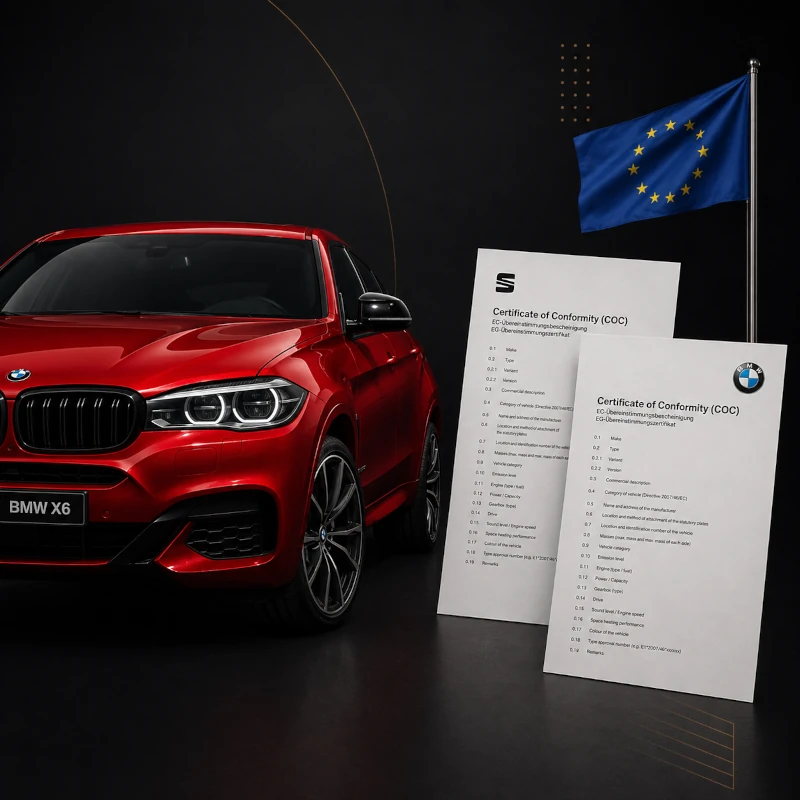
The information contained in a COC can include, depending on the vehicle and type approval:
- Vehicle manufacturer
- Vehicle Identification Number (VIN)
- Make and commercial name
- Vehicle type, variant and version
- European type-approval number
- Vehicle category
- Number of seats
- Engine characteristics
- Fuel type
- Maximum power
- Vehicle dimensions
- Vehicle mass and maximum authorised mass
- Axle information
- Approved tyre and wheel dimensions
- Emissions information
- CO₂ emissions
- Fuel consumption
- Exhaust emission standard
- Noise levels
- Technical homologation data
Because this information is linked to the approved configuration of the vehicle, the COC can play an important role during vehicle registration procedures in Europe.
When Do You Need a Certificate of Conformity for a Car?
A car Certificate of Conformity may be requested in several situations, particularly when a vehicle moves from one country to another.
One of the most common situations is the registration of a car imported from another European country.
For example, you may need vehicle conformity documentation if you:
- Purchase a used car in another EU country
- Purchase a new vehicle abroad
- Import a vehicle into your country of residence
- Export your vehicle to another European country
- Move residence and take your car with you
- Need to register an imported vehicle
- Need technical information requested by a registration authority
- Have lost the original Certificate of Conformity
- Purchased a vehicle without the original COC
- Need homologation information for an administrative procedure
The exact documentation required always depends on the country, authority, vehicle and registration procedure. For this reason, it is advisable to confirm the required documents with the competent registration authority before submitting an application.
COC for M1 Passenger Vehicles
This category is dedicated specifically to M1 passenger cars.
Category M1 generally includes standard passenger vehicles designed to transport people. This covers a very large proportion of cars used on European roads, including hatchbacks, saloons, estates, SUVs, crossovers, coupés, convertibles and many electric vehicles.
Examples can include vehicles such as:
BMW 1 Series, 3 Series, 5 Series, X1, X3, X5 and X6; Audi A1, A3, A4, A6, Q3, Q5 and Q7; Mercedes-Benz A-Class, C-Class, E-Class, GLC and GLE; Volkswagen Golf, Polo, Passat, Tiguan and Touareg; Peugeot 208, 308, 3008 and 5008; Renault Clio, Captur, Mégane and Arkana; and many other passenger vehicles.
If you are looking for a COC for a motorcycle, commercial vehicle, van, camper or motorhome, select the relevant vehicle category instead.
Find Your Car COC by Manufacturer
FastCOC organises Certificates of Conformity by vehicle manufacturer to make it easier to find the correct product.
Simply select the brand of your passenger vehicle or use the search function above.
Our passenger car catalogue includes many popular manufacturers such as:
Abarth, Alfa Romeo, Aston Martin, Audi, Bentley, BMW, Bugatti, BYD, Cadillac, Chevrolet, Chrysler, Citroën, Cupra, Dacia, Daewoo, Daihatsu, Dodge, DS Automobiles, Ferrari, Fiat, Ford, Honda, Hummer, Hyundai, Infiniti, Isuzu, Jaguar, Jeep, Kia, Lamborghini, Lancia, Land Rover, Lexus, Lotus, Lynk & Co, Maserati, Mazda, McLaren, Mercedes-Benz, MG, MINI, Mitsubishi, Nissan, Opel, Peugeot, Polestar, Porsche, Renault, Rolls-Royce, Rover, Saab, SEAT, Škoda, Smart, SsangYong, Subaru, Suzuki, Tesla, Toyota, Vauxhall, Volkswagen and Volvo.
Available manufacturers may vary depending on the vehicle category and the possibility of obtaining the required conformity documentation.
European Certificate of Conformity for Imported Cars
Importing a car from another European country can involve several administrative steps.
Registration authorities often need to verify the vehicle’s technical characteristics before issuing local registration documents. A European Certificate of Conformity can provide many of the technical specifications associated with the vehicle’s European type approval.
This is particularly relevant for vehicles originally sold in one EU or EEA country and later registered in another.
For example, a customer may purchase a car in Germany and register it in France, Spain, Italy, Portugal, Belgium, the Netherlands or another European country.
Depending on the individual registration procedure, authorities may request the COC or equivalent technical documentation.
COC for Used Cars
A Certificate of Conformity is not only relevant for new vehicles.
Many customers search for a COC for a used car because the original document was lost, was never supplied by the previous owner or is required during an import or registration procedure.
Used vehicles can change owners and countries several times during their lifetime, and the original paperwork is not always transferred with the car.
If your vehicle no longer has its original COC, you can search for the appropriate manufacturer on this page and submit the vehicle information required for processing.
COC for Cars Imported from Germany
Germany has one of Europe’s largest used-car markets, and many vehicles are exported every year to other European countries.
If you have purchased a vehicle in Germany and need to register it abroad, you may be searching for a COC for a German imported car.
Vehicles from manufacturers such as BMW, Mercedes-Benz, Audi, Volkswagen, Porsche, Opel and MINI are frequently imported from Germany, although vehicles from almost every major manufacturer are available on the German market.
The Certificate of Conformity may provide important homologation information needed as part of the registration process in the destination country.
COC for Cars Imported into France
A Certificate of Conformity is commonly associated with vehicle registration procedures involving imported cars in France.
Customers importing vehicles from Germany, Belgium, Luxembourg, the Netherlands, Italy, Spain and other European countries may need technical conformity documentation when preparing their registration application.
The exact requirements depend on the vehicle and administrative situation, so you should always verify the current requirements with the relevant French authority.
COC for Cars Imported into Spain
If you are importing a passenger car into Spain, several documents may be required during the registration and inspection process.
A European COC for a car can be useful because it contains technical specifications connected with the vehicle’s European approval.
Depending on the vehicle, age and registration situation, additional documentation or technical procedures may also be required.
COC for Cars Imported into Italy
Vehicles imported into Italy from another EU country can also require conformity and technical information during the registration procedure.
The COC can help identify important vehicle data including European type approval, vehicle category, engine specifications, emissions information, approved masses and tyre dimensions.
Requirements can vary, particularly for older vehicles or vehicles that do not have European whole vehicle type approval.
COC for Electric and Hybrid Passenger Cars
The passenger car market now includes a growing number of electric and plug-in hybrid vehicles.
FastCOC can also support many electric and hybrid passenger cars, depending on manufacturer and vehicle approval.
A COC for an electric or hybrid vehicle can contain information such as:
- Electric motor power
- Fuel and energy type
- Electric energy consumption
- CO₂ emissions
- Electric range
- Vehicle mass
- Type approval
- Tyre specifications
- Vehicle dimensions
- Technical drivetrain information
Popular electric vehicle brands and models include vehicles from Tesla, BMW, Mercedes-Benz, Volkswagen, Audi, Porsche, Hyundai, Kia, Polestar, Volvo, BYD, MG and many others.
Find Your COC Using the VIN Number
If you are unsure which manufacturer category to select, the VIN Finder can help identify the vehicle manufacturer from the Vehicle Identification Number.
A standard VIN contains 17 characters and can usually be found on:
- The vehicle registration document
- The dashboard near the windscreen
- The driver’s door frame or pillar
- The vehicle chassis
- Manufacturer identification plates
Enter the complete VIN into our VIN search tool to identify the manufacturer and navigate to the relevant COC product.
Always check the VIN carefully before submitting your order. A single incorrect character may refer to a different vehicle or prevent the vehicle from being identified correctly.
Digital COC and Physical Document Delivery
Depending on the selected service and manufacturer, COC documentation may be available digitally and/or as a physical document.
Digital documentation can provide a convenient way to receive the available document quickly by email.
Where physical delivery is available or required, the document can also be shipped according to the delivery conditions indicated during the ordering process.
Check the individual product page and Issuing Times information for the expected processing and delivery options.
Why Vehicle Data Must Be Accurate
A Certificate of Conformity is associated with a specific vehicle configuration, which is why accurate vehicle information is essential.
When entering your VIN or uploading vehicle documentation, make sure all information is clear and correct.
In particular, verify:
- VIN number
- Manufacturer
- Model
- Vehicle registration document
Providing accurate information helps avoid delays and allows the correct vehicle documentation to be identified.
Passenger Car COC for European Registration
A major reason customers order a COC is to support the registration of a passenger car in another European country.
Europe has a large cross-border vehicle market. Cars are frequently purchased in one country and registered in another, especially between countries such as Germany, France, Belgium, the Netherlands, Spain, Italy, Austria, Luxembourg and Portugal.
European vehicle type approval helps harmonise technical standards between participating countries. The COC contains vehicle information connected to this approval and can therefore be particularly useful during cross-border registration procedures.
However, registration procedures are controlled by national authorities, and additional documents may be required depending on the destination country.
What Information Do I Need to Order a COC?
In most cases, the most important piece of information is the 17-character VIN number.
Depending on the manufacturer and vehicle, you may also need to provide a copy or photograph of the vehicle registration certificate or additional identifying information.
The VIN enables the vehicle to be distinguished from other cars of the same manufacturer and model.
Before placing an order, make sure your VIN is complete and readable.
Can I Get a COC If I Lost the Original?
If the original Certificate of Conformity supplied with the vehicle is no longer available, it may still be possible to obtain the relevant conformity documentation, depending on the manufacturer, vehicle and type approval.
This is a common situation with older used cars, imported vehicles and vehicles that have passed through several owners.
Select your vehicle manufacturer above to view the available COC service.
Is Every Passenger Car Eligible for a European COC?
Not every vehicle necessarily has a European Certificate of Conformity.
Eligibility can depend on factors such as:
- Vehicle manufacturer
- Model
- Production year
- Market of first sale
- European type approval
- Vehicle category
- Individual or national approval
- Vehicle modifications
Vehicles originally manufactured for markets outside Europe may not always have an EC/EU Certificate of Conformity.
Older vehicles produced before the relevant European type-approval system applied to that model may also require alternative technical documentation.
If you are unsure, check the information on the relevant manufacturer product page before ordering.
COC for European Car Brands
FastCOC covers a wide range of major European passenger car manufacturers.
You can search for COC documentation for German brands such as Audi, BMW, Mercedes-Benz, Porsche, Opel and Volkswagen, French brands such as Citroën, Peugeot, Renault and DS, Italian brands including Fiat, Alfa Romeo, Abarth, Ferrari, Maserati and Lamborghini, as well as manufacturers from many other European countries.
Our catalogue also includes many Asian, American and international manufacturers where European passenger vehicle conformity documentation is available.
Order Your Passenger Car Certificate of Conformity Online
Finding the right COC for your passenger car should not be complicated.
Use the products listed on this page to select your manufacturer, or search directly by brand. You can then access the appropriate product page, review the issuing information and submit the required vehicle details.
Whether you need a BMW COC, Mercedes COC, Audi COC, Volkswagen COC, Peugeot COC, Renault COC, Fiat COC, Ford COC, Toyota COC, Tesla COC or a Certificate of Conformity for another passenger car manufacturer, FastCOC allows you to locate the relevant service from one central catalogue.
Start by choosing your vehicle brand above and find the Certificate of Conformity for your passenger car.